Documentation Philosophy
This documentation follows the Diátaxis framework - a systematic approach to technical documentation that organizes content by user needs rather than topic.
Last updated convention: We add a "Last updated" footer on hub pages (index pages). For detailed change history, rely on git history.
Why Diátaxis?
Most documentation fails because it mixes different types of content together. A tutorial suddenly becomes a reference guide. An explanation drifts into how-to instructions. The result is documentation that's hard to navigate and hard to maintain.
Diátaxis solves this by recognizing that documentation serves four distinct purposes, each requiring different content and writing styles.
The Four Quadrants
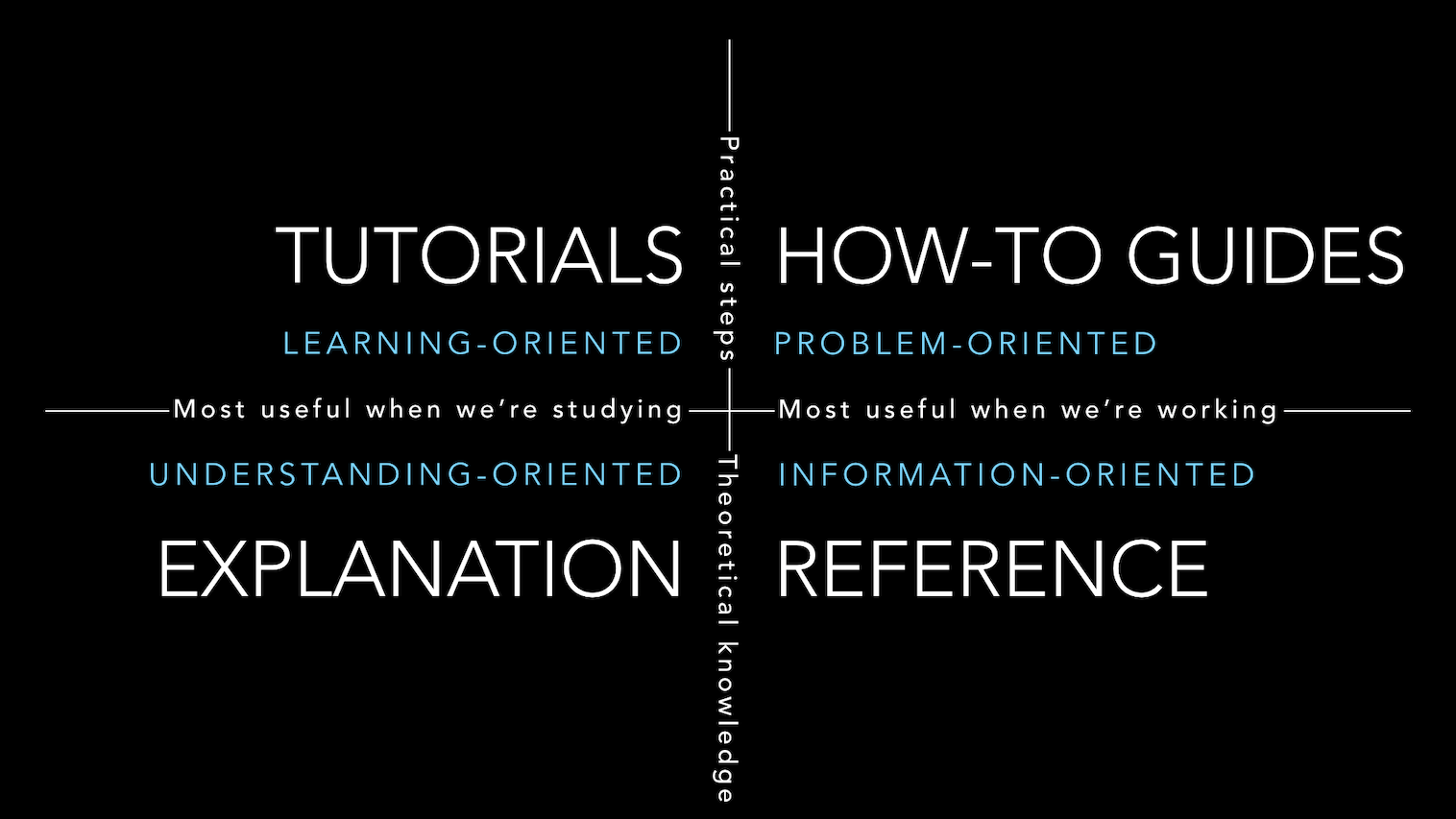
Tutorials (Learning-Oriented)
Location: Get Started
Purpose: Take users by the hand through a series of steps to complete a project.
Characteristics:
- Learning-oriented
- Assumes no prior knowledge
- Shows the user that they can do something
- Gives the user a successful experience
Example: "Your First Content Audit" walks through a complete audit workflow step-by-step.
How-to Guides (Task-Oriented)
Location: How-to
Purpose: Help users accomplish a specific task.
Characteristics:
- Goal-oriented
- Assumes some knowledge
- Shows the user how to do something
- Solves a specific problem
Example: "Configure MCP Servers" explains how to set up BigQuery, DataForSEO, and Wrike connections.
Reference (Information-Oriented)
Location: Reference
Purpose: Provide technical descriptions of the system.
Characteristics:
- Information-oriented
- Describes the machinery
- Accurate and complete
- Organized for quick lookup
Example: "Command Reference" lists all commands with their parameters and outputs.
Explanation (Understanding-Oriented)
Location: Explanation
Purpose: Clarify and illuminate topics through discussion.
Characteristics:
- Understanding-oriented
- Provides context and background
- Explains why things are the way they are
- Can be read at leisure, away from the keyboard
Example: "Architecture" explains the layered plugin system and design decisions.
How Our Docs Map to Diátaxis
| Section | Diátaxis Type | User Need |
|---|---|---|
| Get Started | Tutorials | "I want to learn" |
| Features | Reference + Tutorials | "What can this do?" |
| How-to | How-to Guides | "I need to accomplish X" |
| Reference | Reference | "I need to look up Y" |
| Explanation | Explanation | "I want to understand why" |
The "Features" Addition
Our documentation extends Diátaxis with a Features section. This is a practical addition that serves as:
- A product showcase for new users discovering capabilities
- A bridge between tutorials and reference
- A navigation aid for users who know what they want but not where to find it
Divio's own documentation uses this pattern with their Features section.
Writing Guidelines by Section
Get Started (Tutorials)
- Write in second person ("you")
- Be encouraging and positive
- Include every step, even obvious ones
- Don't explain - just show what to do
- End with a working result
How-to (Guides)
- Start with a clear goal statement
- Assume the reader knows what they want
- Be direct and practical
- Don't teach - just solve the problem
Reference
- Be complete and accurate
- Use consistent formatting
- Don't explain why - just describe what
- Organize for lookup, not reading
Explanation
- Take time to explore topics
- Provide context and background
- Discuss alternatives and trade-offs
- Connect to the bigger picture
Further Reading
- Diátaxis Framework - The original framework documentation
- The Documentation System - Divio's guide to the system
- What nobody tells you about documentation - Daniele Procida's PyCon talk
Contributing to Documentation
When adding new documentation:
- Identify the quadrant - What user need does this serve?
- Follow the conventions - Use the writing style for that quadrant
- Link appropriately - Cross-reference related content in other quadrants
- Don't mix types - Keep tutorials separate from reference, etc.
See Contributing for detailed guidelines.